

If you have read our other blog posts, it’s no surprise that Gen Z’s behaviour in the workplace is partially a consequence of growing up online, entering adulthood during a global pandemic, and other things that seem to have a defining impact.
Alongside our workplace behaviour sit our career expectations: personal beliefs about what our professional careers will look like in the future. For example, our beliefs about the amount of compensation we should receive and the growth opportunities.
Every time a new generation enters the workforce, it forms the perfect breeding ground for complaints from older generations. Common complaints about Gen Z centre around their high expectations without the necessary experience or skills to justify such demands. That forms the premise of this blog post, in which we focus on the different career expectations between Gen Z and other generations.
Of course, the mismatch in career expectations between generations (or between workers and employers) is nothing new. They’ve existed every time a new cohort steps into the workforce. This doesn’t take away from the fact that it’s important to gain an understanding of these mismatches to prevent negative job satisfaction, and for organisations, a high turnover, weaker talent pipelines, and suboptimal performance. That’s why we will lay out some tips for Gen Z workers, but also for employers and other generations.
Gen Z makes up 27% of the current workforce, and is projected to be the largest generation in the workforce by 2035. So now is the perfect time to dive into the generational differences regarding career expectations.
Points of mismatch
Compensation/salary expectations

Gen Z is entering the workforce with higher salary expectations compared to previous generations. To some employers, this comes across as entitlement, stemming from the belief that a high salary is not something you receive from the get-go, but something you must work towards.
But experts are debunking these entitlement claims to some extent by pointing out that Gen Z just wants to cover their living costs. According to a study by Deloitte (2025), almost half of Gen Z say they don’t feel financially secure, and more than half are living from pay check to pay check. In today’s economic climate, their high salary expectations are maybe a mere reflection of what they think is needed to live a comfortable life.
Another reason shaping high salary expectations is social media. The success stories and luxury lifestyles going around on social media create a distorted view of what “normal” success looks like. Remember, these posts are curated snapshots that rarely show the years of effort, privilege, or luck behind them. Yet, they subtly shift perceptions, making financial comfort seem like something everyone else already has.
Unfortunately for Gen Z, their salary expectations are not being met, and this disconnect with economic reality can lead to considerable disappointments.
Engagement commitment
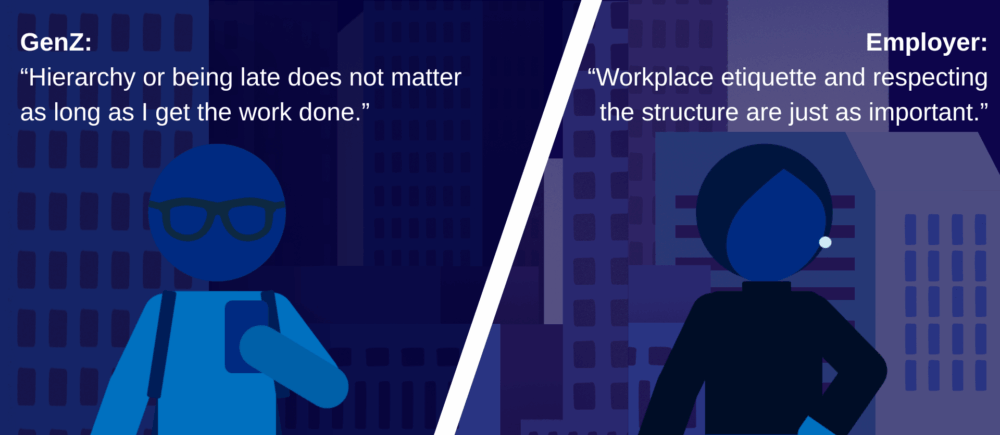
52.8 % of the employers think Gen Z needs to improve their office/workplace etiquette, and 73.7 % of Gen Z employees rate their etiquette skills as excellent or good. The lack of these skills from the employer’s perspective gets translated into disengagement from commitment to structure or the absence of respect for it.
At the same time, Gen Z is also struggling with the unwritten rules of organisational life. However, most people in authority do understand that most of these issues stem from a lack of work experience, social and work/study interactions, or remote work due to the pandemic. Hence, despite being the tech-savvy generation, they believe that Gen Z has a few steps to catch up on when it comes to people skills.
Career advancement expectations
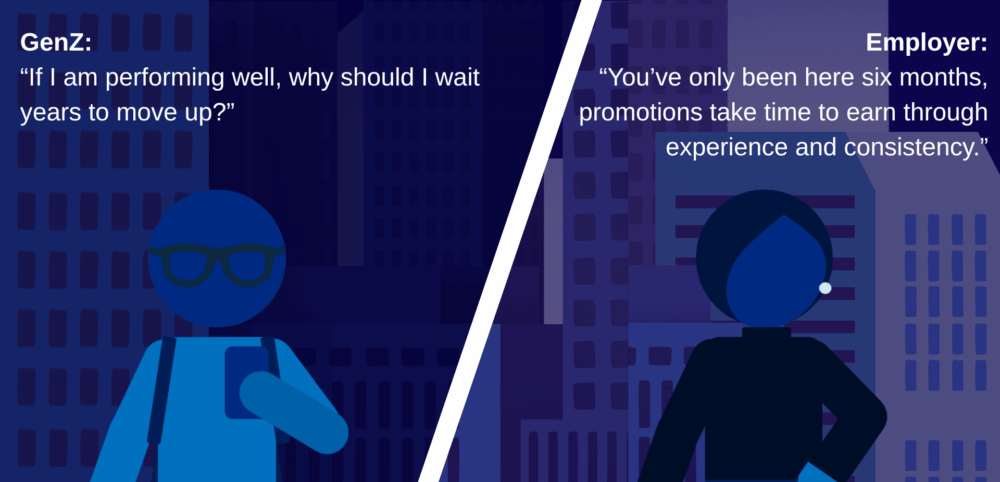
Different generations have varying opinions and beliefs about how promotions should be offered. While baby boomers believe that experience is the key measure for promotion, millennials hold that contributing more would help them move up. On the other hand, 70% of Gen Z want to be promoted within the first 18 months, although this figure has decreased a bit over the last year because of shifts in the labour market (interns/entry-level professionals are finding it difficult to find work).
According to older generations, patience as a virtue and the notion of building expertise over time have been replaced by the search for rapid growth and acceleration in one’s career. The need for employers to provide mentorship to grow and not simply oversee tasks is also becoming a growing perception. While this thought is not a problem, the obsession over instant success could be an issue.
Certain factors that are very characteristic of this generation could be the culprit for this disposition, and unknowingly, Gen Z is being affected by it. One of the many is the comparison culture that is mediated by social media. Watching people their age on the other side of the world building businesses or earning six figures, understandably, instils a sense of inadequacy. This feeling gets carried into the workplace and leads to disillusionment with reality. This also acts as an anxiety amplifier when expectations are not met, where 40% of Gen Z feel stressed.
Another reason could be access to knowledge (online courses, YouTube tutorials, etc), creating a belief that they are immediately ready for the next level. Even though seeking continuous learning is a good trait, Gen Z should also realise that these skills are complemented by other important interpersonal skills developed in the workplace.
These aspects could sometimes give Gen Z the impression of seeking instant gratification with disregard for the relevant and useful norms among employers or the older generations.
How to navigate this?
It is helpful when the willingness to listen to and engage in a conversation or discussion with the other party precedes other points of action. This puts the topic of mismatch on the table and opens negotiation for both ends, and of course, being open to potentially accepting each other’s expectations is key here. Having said that, here are some suggestions for employers and Gen Z job seekers that could be useful in navigating the generational gap.
For employers
1. Present a clear career trajectory
With their high salary expectations and desire for rapid career advancement, it’s clear that Gen Z is looking to make a meaningful impact from the very first day. While they may not be ready to step into senior roles immediately, employers can still harness that ambition by offering clear guidance through mentorship programmes and regular, informal feedback sessions.
There also needs to be clear communication about what skills and experiences are needed for future success in senior roles, and to be transparent about the time it takes to get there. In gaining a clearer picture of the path that lies ahead, they can become more patient and engaged.
2. Offer upskilling opportunities
Upskilling not only appeals to Gen Z’s desire for growth, but it also helps them understand the unfamiliar intricacies of organisational life. Job shadowing and mentorship programs can provide workers with valuable insights into how a workplace actually operates. This can be complemented with courses from online learning platforms focused on either professional or industry-specific skills.
3. Fostering innovation
To strengthen the engagement of Gen Z, employers can provide opportunities in which creativity and autonomy play a central role. Invite them to participate in innovation projects where their fresh perspectives can genuinely influence outcomes.
For Gen Z workers/job seekers
1. Manage your expectations
It’s important to recognise that meeting every expectation right away is tough. When expectations seem unreasonably high, employers may worry that you’re a flight risk, which can make them hesitant to invest in your development if they suspect that loyalty won’t always follow.
That’s why it’s important to manage your expectations, no matter what generation you are from. A helpful way to do this is by prioritising what you truly need. Separate your must-haves from your nice-to-haves, and focus on finding a job that meets those core essentials.
2. Adapt to workplace norms
Workplace norms are shaped collectively. As new generations enter the workforce, these norms naturally evolve. While it’s an oversimplification to suggest that only Gen Z needs to adapt, it’s also unrealistic to expect the workplace to bend to every new preference. So, employers should stay open to change, and Gen Z should adapt. To do this, you can observe how colleagues interact with each other and adapt your behaviour accordingly.
3. Practice patience
The instant output and gratification culture Gen Z grew up in can create the false sense that everything moves fast. In return, it makes career progression seem very slow. But, as our older peers have been telling us, building a career and gaining credibility takes time. Remember, practicing patience is not compromising your ambition. Celebrate small wins and have ongoing conversations with your employer about how you can work towards your long-term goals.
Conclusion
In theory, the tips suggested above should aid in steering through the generational gap; however, there is no standard set of guiding rules that will resolve the issue. This misalignment in expectations, despite our aversion towards it, will be a recurring phenomenon every time a new cohort steps into the job market. It is also true that every time this happens, opinions and beliefs from both sides will conflict.
Expecting that our beliefs will be challenged could already be a start in preparing for an upcoming generation. This will eliminate the surprise element for both the job seeker and employer. Even though changing and adjusting our beliefs seems daunting, especially the embedded ones, expecting contradiction and divergence in opinions might soothe the blow to some extent.
In the end, tolerance and patience seem to be the underlying foundation for moving through this, followed by some actionable steps.
Keen to know more about GenZ at work? Check our previous blogs about GenZ versus the job market, Not career ladders, but Lily pads, and GenZ imposter syndrome.
Blog post written by Fleur van der Kooij & Anindita Kalita for Expertise in Labour Mobility
Image by Jizelle Ys for CareerProfessor.works
© 2025 CareerProfessor.works. All Rights Reserved.


